Bio
Hello and welcome to my page!
I am a novice astrophotographer, based in South Wales. The main aim of this webpage is to share some of what I consider my best shots from my astrophotography setups.
As the page grows I hope to review the products I'm using and share workflow ideas for post-processing.
A bit more about me and my astrophotography journey can be found below. To go straight to the images please pick a gallery from the top menu. If you would like to contact me please use the form below.
Thank you!
As far back as I can remember I have always been fascinated by space. Growing up, one of my first memories is tinkering with a refractor with a dented and fractured front element, which originally belonged to my older sister (we won't mention who dented and fractured it...) Still, there I was, trying to focus on the moon whilst resting it on a window ledge and trying to get my head round why everything was upside down (it was also missing an erecting prism!). Those few glimpses of the lunar surface were enough to keep me trying. Then life happened and I somehow forgot about my childhood fascination with space.
Fast forward to 2024, when a planetary alignment was due to happen, my husband bought me a small refractor from eBay as a surprise. Minus the broken parts of the one I'd used as a toddler, it wasn't all that different. Armed with some very basic 20 and 10mm Plossls ,I attempted to observe the planetary alignment and failed... but I did catch a glimpse of Jupiter and its bands. That's all it took... interest well and truly reignited and every clear evening I was looking forward to catching sight of whatever I could.
The 80mm beginner refractor quickly got updated to a beastly 12" Dobsonian, and the plossls were quickly swapped out for decent 2" eyepieces and UWA 1.25" eyepieces. It was with this I started to get my head round collimation and the ture power of the light-bucket reflector I now owned. I will never forget the first time I viewed Saturn and Jupiter through this scope. I was well and truly hooked. I tried my hardest to capture these moments. From trialing various phone adaptors to trialing my DSLR, to learning about stacking software and purchasing a very basic astrophotography camera - all without success. My eyes were still seeing a lot more than I was able to capture with these tools. After various attempts, I decided, observation was going to have to be enough (until it wasn't...)
It was around this time that "smart scopes" started to surface. Like many others I had my doubts when I first came across these. It couldn't be true, could it? They MUST be using AI... they must be downloading images from the internet... I know now that this was just a lack of knowledge and understanding on my behalf.
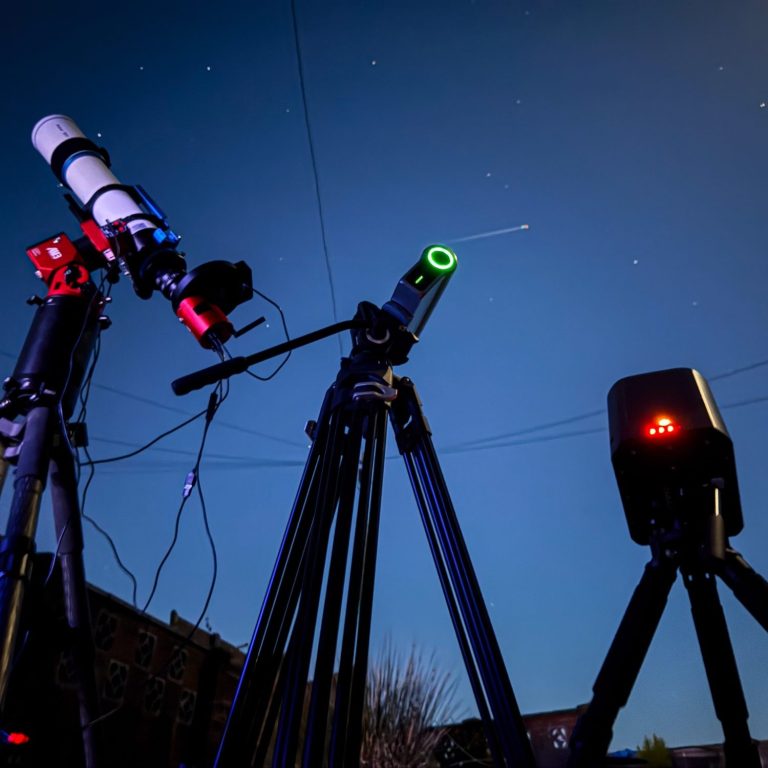
After seeing the imagery being produced by these smart scopes, I decided it was time for me to get my hands on one. The two contenders: The Seestar S50 and the Dwarf 3. Both boasting some incredible specs for the price and both clearly capable of producing high quality images of the night sky. After countless hours of research, I decided to purchase the Seestar S50 and less than a month later the Dwarf 3 had also made its way to my online basket!
From this point on, the lines between hobby and addiction started to blur! Every single clear evening, I was excited to set up and align my two scopes, ready to capture photons from the past. The next morning is akin to waking up on Christmas Day, checking to see what you have captured. The vastness of space started to really dawn on me; how a tiny frame can capture entire galaxies is something that still blows my mind.
By late 2025, I was ready for my next challenge. A dedicated astrophotography rig was my next dream, and in November at the IAS 2025, Alex from First Light Optics helped me make that dream a reality. New toys to play with included:
An apochromatic quadruplet refractor (Askar 91F), a cooled camera (ASI585MC Air), a harmonic drive mount (AM3N), an EAF Pro, an electronic filter wheel, 2 narrowband 7nm filters (Svbony HaO3 and S2O3) and a broadband filter (Optolong L-Quad enhance). Yes... I went a bit crazy.
Getting the most out of my images became my next mission. Various YouTube tutorials later, I was starting to get my head around using Siril and other free software to edit my images. As difficult as this was to start, it was equally rewarding when I started seeing the results of my efforts. The next stop, as for many of us in this hobby, Pixinsight. The learning curve here was even steeper but again, the results I obtained were worth it.
Those views of Saturn and Jupiter that lured my into the realm of astrophotography are most probably next on the list; but for now I am happy to be able to capture DSOs with my gear. And if you've somehow made it this far, thank you for reading and I hope you also take some joy from the images I share here. If you have a query or comment on my work please do not hesitate to use the form below.